
In the park area surrounding the buildings where I live, there are lots of different kinds of trees.
Some of them are crab apple trees, with small apple-kind of (sour!) fruits in the autumn – and lovely white blossoms in the spring. This time of year, dressed in white and fresh green, they give a crisp, dreamy, almost breathtaking kind of beauty… And in the autumn they bring a sense of ripeness even if we don’t eat their fruit.

Follow Me!

Click on the image
Showing posts with label spring. Show all posts
Showing posts with label spring. Show all posts
Saturday, 5 June 2010
Apple Blossom

Thursday, 3 June 2010
Lily of the Valley

Lily of the Valley – Convallaria majalis - Liljekonvalj
I found these growing along the fence of a garden I happened to be passing.
They also grow wild, but it’s not the kind of flower that you find “everywhere”.
It is also known as Our Lady's tears or Mary’s tears. One legend states that Mary's tears turned to lily of the valley when she cried at the crucifixion of Jesus.
In religious paintings it is a symbol of humility.
In the "language of flowers", it signifies the return of happiness.
Lily of the valley has been used for medicinal purposes. It is believed to strengthen memory, to restore speech and as a liquor smeared on the forehead and the back of the neck, to make one have good common sense. Careful, though - despite its alleged powers, the plant is poisonous. (I remember being told as a child to wash my hands after I had picked these fragrant flowers.)
Wednesday, 26 May 2010
Forget-Me-Not

Forget-me-not - Myosotis scorpioides – Förgätmigej
I found these growing beside the river. I love it when I find wild flowers growing “in town”!
The Forget-Me-Not has the same name in several languages (Swedish included).
There are a number of legends about the origin of the name:
In a German legend, God named all the plants when a tiny unnamed one cried out, "Forget-me-not, O Lord!" God replied, "That shall be your name." In a similar legend, the little flower cried out, "Forget-me-not!" as Adam and Eve left the Garden of Eden.
Another legend says that the Christ Child was sitting on Mary's lap one day and said that he wished that future generations could see her eyes. He touched her eyes and then waved his hand over the ground and blue forget-me-nots appeared.
One legend has it that in medieval times, a knight and his lady were walking along the side of a river. He picked a posy of flowers, but because of the weight of his armour he fell into the river. As he was drowning he threw the posy to his loved one and shouted "Forget-me-not".
This is a flower connected with romance and tragic fate. It was often worn by ladies as a sign of faithfulness and enduring love. In 15th-century Germany, it was supposed that the wearers of this flower would not be forgotten by their lovers.
Saturday, 22 May 2010
Yet Another Narcissus

Just as I thought I had the daffodil/narcissus definitions more or less sorted out, I ran into this one! It is the exact same shape as the yellow ones I think of as daffodils (Swedish påsklilja=Easter lily). See the middle picture in the collage in the previous Narcissi post. But - this one is all white!!! (In my mind a White Daffodil rather than a typical Narcissus!) I give up… (LOL)
Friday, 21 May 2010
A Dream In White

Not quite sure about what kind of tree, but probably Whitebeam - Sorbus – Vitoxel
It is a huge tree, and this photo was taken from below looking up and zooming.
Thursday, 20 May 2010

Wednesday, 19 May 2010

Tuesday, 18 May 2010
More Narcissi

In a Narcissus post last week I mentioned that in Sweden we use different names for the yellow ones (middle picture in this collage) and the white ones. (‘Easter Lily’ vs ‘Pentecost Lily’)
Hmm… Since then, just on my recent walks in the neighbourhood of where I live, I’ve realized that the distinction is not always as easy to make as it may seem at first glance…


Monday, 17 May 2010


Sunday, 16 May 2010
Common Daisy – Bellis perennis - Tusensköna

“The splendor of the rose and the whiteness of the lily do not rob the little violet of it’s scent nor the daisy of its simple charm. If every tiny flower wanted to be a rose, spring would lose its loveliness.” ~ Therese of Lisieux ~

Daisies and Dandelions
The Swedish name for the daisy - Tusensköna – means “thousandfold beauty”.
From my childhood, I remember these especially from one place I used to visit with my grandparents. They had these three old friends, two sisters and a brother, who lived together in a little red wooden cottage far out in the countryside. These little white flowers covered the whole lawn in front of that house, and therefore the name always seemed very appropriate to me.
Saturday, 15 May 2010


Thursday, 13 May 2010
Narcissus


The English Wikipedia article puts these two together under the name Daffodil or Narcissus (plural Narcissuses or Narcissi in BE, Narcissus in AE).
There are two derivations of the name Narcissus. One is that of a young man in Greek mythology who became so obsessed with his own reflection in a pool that he fell into the water and drowned. The Narcissus plant first sprang from where he died.
The other derivation is that the plant is named after its narcotic properties (ναρκάω narkao, "to grow numb" in Greek). All Narcissus varieties contain the alkaloid poison lycorine. The name Daffodil is derived from an earlier "Affodell", a variant of Asphodel. In Greek legend the asphodel is one of the most famous plants connected with the dead and the underworld.
In Swedish we have different names for these two Narcissi: We call the yellow one “påsklilja”, which means Easter Lily, and the white one “pingstlilja”, which means Pentecost Lily. (This will tell you that the yellow ones usually appear a bit earlier than the white ones, in our climate.) Because the yellow one is associated with Easter and early spring, it is also often used as a symbol of Life and Resurrection rather than Death. We do also use the name “narciss”, but most people associate that with the white one rather than with the yellow one.
Looking up them up in lists of Flower Language – in Swedish – I find these symbolic uses:
Yellow Narcissus (Påsklilja): “I can’t bear the thought of losing you.”
White Narcissus (Pingstlilja): “I love – but not you!”
Wednesday, 12 May 2010
Dandelion – Taraxacum - Maskros

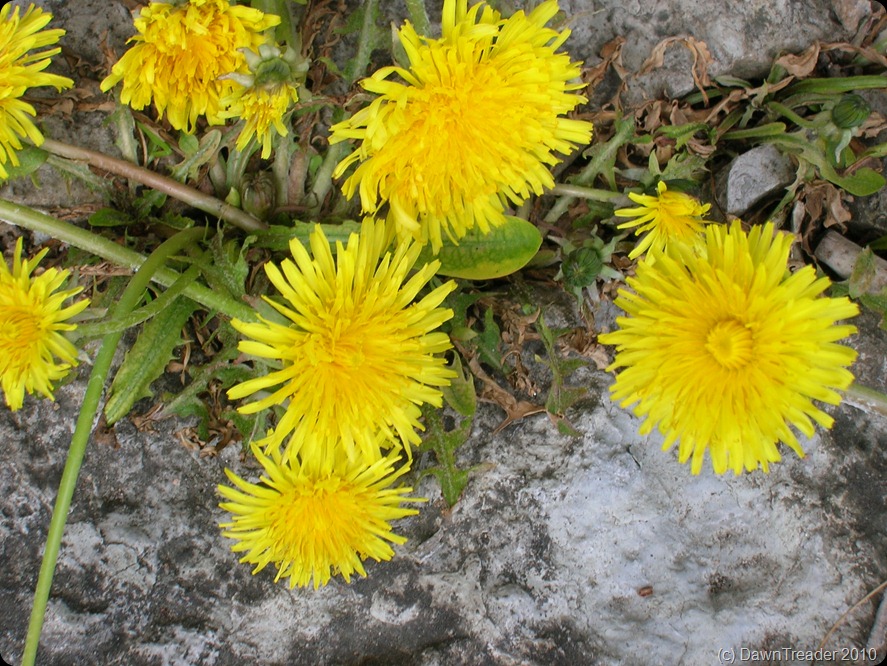
Dandelion – Taraxacum – Maskros
The English name dandelion is a corruption of the French dent de lion meaning "lion's tooth", referring to the coarsely toothed leaves.
The Swedish name maskros means "worm rose", which is said to have to do with the small insects usually present in the flowers.
I’m rather surprised that this flower doesn’t seem come with a whole range of alternative popular names, as many of the other wild spring flowers do.
Dandelions are thought to have evolved about thirty million years ago in Eurasia; they have been used by humans for food and as a herb for much of recorded history. They were introduced to North America by early European immigrants.
It is considered a weed and here people usually don’t want it in their lawns. But it is actually a beneficial weed, with a wide range of uses. It has been described as "a plant for which we once knew the use but we've forgotten it". Did you know, for example, that…
- Its ability to break up hard earth with its deep tap root, bringing up nutrients from below the reach of other plants, makes it a good companion for weaker or shallower-rooted crops, including tomato plants.
- Dandelions are important plants for bees as an important source of nectar and pollen early in the season.
- A cup of dandelion leaves contains 112% daily recommendation of vitamin A, 32% of vitamin C, and 535% of vitamin K and 218 mg potassium, 103 mg calcium, and 1.7 mg of iron.
- Dandelions leaves can be picked in the early spring before they become tough. They are best before the flowers bloom.
- The flowers can be sauteed in butter or oil as a vegetable dish, or dipped in tempura batter and fried. The flower petals, along with other ingredients, are used to make dandelion wine.
- The roasted, ground roots can be used as a caffeine-free dandelion coffee.
- The root can also be cooked and eaten.
- Dandelions, flowers, roots and leaves, have been used for centuries in traditional Chinese medicine & medicinal teas, most notably for liver detoxification and as a natural diuretic.
- Dandelion pollen however is a common allergen and may be responsible for asthma, allergic rhinitis, allergic conjunctivitis and contact dermatitis in sensitive individuals.
(Most of the facts from the Wikipedia article.)
Tuesday, 11 May 2010
Coltsfoot – Tussilago farfara


Coltsfoot – Tussilago farfara – Hästhov / Tussilago
The Swedish name Hästhov means Horse’s Hoof.
The flowers (which superficially resemble dandelions) appear early in the spring, on stems with no apparent leaves. The leaves, which resemble a colt's foot in cross section, do not appear until after the seeds are set.
The Latin name "tussilago" means cough suppressant. The plant has been used historically to treat lung ailments such as asthma as well as various coughs by way of smoking. Crushed flowers supposedly cured skin conditions, and the plant has also been consumed as a food product. Caution, though - there are documented cases of it causing severe liver problems in infants.
Alternative English names include Tash Plant (I’m curious about the origin of that!), Ass's foot, Bull's foot, Butterbur, Coughwort, Foal's foot, Foalswort, Horse Foot and Winter heliotrope. (Source: Wikipedia)
Monday, 10 May 2010

Saturday, 8 May 2010
“I’ve lived a very long, long time…”

We thought this tree looked like it might belong in a fantasy tale…
“My name is growing all the time, and I've lived a very long, long time; so my name is like a story. Real names tell you the story of the things they belong to in my language, in the Old Entish as you might say. It is a lovely language, but it takes a very long time to say anything in it, because we do not say anything in it, unless it is worth taking a long time to say, and to listen to.”
Treebeard the Ent in J.R.R. Tolkien’s The Lord of the Rings
(The Two Towers, Chapter 'Treebeard')
Friday, 7 May 2010
Wood Anemones and Hepaticas

Wood Anemones & Hepaticas – Vitsippor & Blåsippor


The white Wood Anemone is our most common wild spring flower.
It grows almost anywhere, and in suitable conditions often form large colonies.


The blue Hepatica is also called Liver Leaf in English, because of the leaf resembling the three lobes of the liver. (It is also sometimes called Liverwort, but that name can also refer to an entirely different flower; see reference in the Wikipedia article.)
The Hepatica is much more rare here than the wood anemone, but in some protected places (like in this nature reserve), colonies of these can also be found.


Thursday, 6 May 2010
Yellow Spring Flowers


While the Pasque flower (see yesterday’s post) seems to prefer a dry meadow, these two like damp ground. I found them both growing close by the river, downstream from the mill.


Lesser Celandine – Ranunculus ficaria – Svalört
Celandine comes from the Latin chelidonia, meaning “of the swallow”. It was said that the flowers bloomed when the swallows returned and faded when they left. The Swedish name, “svalört”, also literally translates “Swallow Herb”. The plant had medicinal uses in the past. The early leaves are high in Vitamin C. Ranunculus is Late Latin for "little frog”.

Marsh-marigold – Caltha palustris - Kabbeleka
From the Wikipedia article I learn that this flower has a lot of different names in the UK: Kingcup, Mayflower, May blob, Water blob, Water bubble… In the US it is sometimes called Cowslip. But in the UK, Cowslip refers to the flower below, which I found growing in the meadow:

Cowslip – Primula veris – Gullviva
Cowslip seems to me a mundane name compared to the Swedish one (“golden flower”).
Among other English names for it I find Our Lady’s Keys or Keys of Heaven. In Swedish too this flower has been called by similar names (Jungfru Marie Nycklar = “Keys of the Virgin Mary”).
I’m learning (or re-learning) a lot by blogging…! ☺
Wednesday, 5 May 2010
Pasque flower - Backsippa

Swedish: Backsippa
Latin: Pulsatilla vulgaris, or Anemone pulsatilla
English names: Pasque flower, Meadow Anemone, Praire Crocus, Windflower.
Pasque refers to Easter (Passover) as the flower blooms around that time of year.
As some of the names indicate, it prefers dry grassy places.
In Sweden, it is rather rare. I don’t think I’ve ever seen it anywhere else but in the nature reserve where I took these pictures. There it grows in a sort of stony meadow/pasture land.


Tuesday, 4 May 2010
Spring Time at the Old Mill

Back in February, I posted pictures of this old mill and waterfall all covered in snow and ice.
The mill is looked after by a local history society, and the little island behind it, embraced by two arms of a river, is a nature reserve area with a many different kinds of trees and flowers – some common, some rare.
We went for a walk there again this first Sunday in May, and that’s where my photos this week will be from. Spring is rather late this year, after a hard winter. The trees were only just at that first hint of green, but some of the early spring flowers at their finest.

“Much water goeth by the mill, that the miller knoweth not of” ~ Proverb

“The mill cannot grind with the water that is past” ~ Proverb

Wood Anemones – Anemone nemorosa - Vitsippa
See close-up photos of wood anemones in yesterday’s post at The Island of the Voices.
Subscribe to:
Posts (Atom)
Subscribe To


 Posts
All Comments
Awards given to DawnTreader's Picture Book

Over-the-Top Award from NPT @ The Nature..., 3 November 2009.
More info at The Island of the Voices.
 |
'Blog of the Week' from Brett @ 365 to 42, 9 November 2009.

From Scriptor Senex @ Rambles From My Chair, 22 November 2009
About Me - DawnTreader
- DawnTreader
- Västergötland, Sweden
- PLEASE NOTE that this blog is no longer being updated, and comments are therefore closed.

Click on the picture to jump over to my "Island of the Voices" blog!
DawnTreader's Picture Book
For this blog, I have chosen a template that allows me to show pictures as big as possible . Some of the things you usually find in the sidebar, you will find here at the bottom of the page instead - Blog Archive, Followers etc.

My camera is a Nikon Coolpix 4600.
For basic editing of most photos and collages I use Picasa 3.
Sometimes I also experiment with some more "artistic" effects in Photoshop Elements or Paint Shop Pro.
YOU WILL ALSO FIND ME HERE:
The Island of the Voices ~♥~ Wordly Efforts ~♥~ Through My Spectrespecs ~♥~ Soaring Through The World